
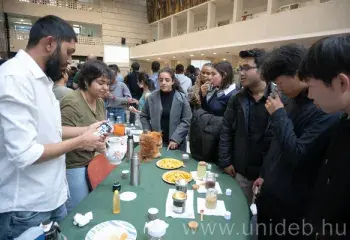
On Thursday, an Orientation Day was held at the Faculty of Agricultural and Food Sciences and Environmental Management of the University of Debrecen. The program was primarily designed to provide assistance to new students enrolled in English-language degree programs with settling in and managing their academic and administrative tasks. Furthermore, participants could try the soup called gulyásleves, make gingerbread, learn straw weaving and even furniture painting.
News

The limitations of artificial intelligence, a sustainable future, and new dimensions of human-animal relationships were among the topics discussed at the Faculty of Education for Children and Special Educational Needs at the University of Debrecen on October 6 and 7. Celebrating its fifth anniversary, the International Anthrozoology Conference hosted 71 speakers from Hungary and abroad this year, who shared their latest research findings across 14 different sessions covering almost every branch of the social and natural sciences.

A truly memorable experience for the nearly 22,000 spectators at this year’s stadium show was entrée of the university’s wind ensemble. called Marching Band, as it made its way to the stage from the stands, marching around the arena floor. A similarly heartwarming moment of the night was the procession of more than a hundred international students carrying the flags of their respective countries. If you wish to recall the yoUDay experience, feel free to click on our videos!
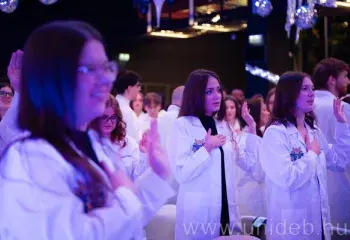
A White Coat Ceremony was held for the first time at the Faculty of Medicine of the University of Debrecen on Saturday. At the end of the ceremony, more than three hundred third-year medical students donned the new white coats that symbolize the transition to preclinical and clinical studies. They also took a symbolic oath, pledging to pursue their studies with dedication and to apply the knowledge gained for the benefit of patients responsibly with empathy and humility.

Visitors to the Chinese Mid-Autumn Festival were awaited with traditional music, dance, culinary specialties, craft workshops and market stands this past weekend. The event was organized along the pedestrian street called Batthyány utca on September 26 by the Confucius Institute of the Faculty of Humanities at the University of Debrecen. The full-day program ended in the evening with a Chinese disco, and all the attendees had the opportunity to try mooncakes, which are a symbolic treat related to this festivity.
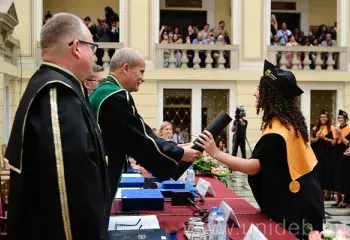
At the University of Debrecen, more than a hundred and twenty newly graduated Hungarian and international students of the Faculty of Medicine took their Hippocratic oath and received their medical degrees and diplomas on Saturday. During the course of the ceremony, the freshly inaugurated physicians were also addressed by a former student of the faculty, medical futurist Bertalan Meskó, who drew their attention to how the new generation of physicians can efficiently use the opportunities offered by artificial intelligence in healing.
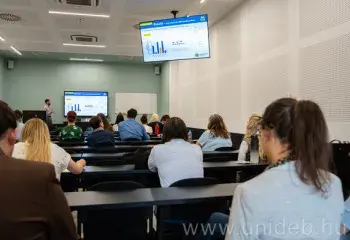
Several presentations were given on topics in pharmacology, pharmaceutical technology, pharmaceutical chemistry, and medical microbiology at the symposium of the Pharmacology and Microbiology Section of the Doctoral School of Medicine at the University of Debrecen. At the event held on Friday at the Faculty of Pharmacy, doctoral students reported on their scientific work and the results of their research to date.
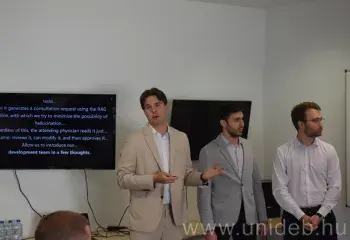
Innovative and multidisciplinary applications of artificial intelligence took center stage at the DEIK.AI Challenge 2026 student competition, organized by the Faculty of Informatics at the University of Debrecen with support from the Innovation Ecosystem Center. The finals of the first stage of this multi-stage competition—the AI Idea Competition—were held at the Faculty of Informatics.

The academic year-opening stadium show of the University of Debrecen, the 10th yoUDay, was held on Wednesday at Nagyerdei Stadium in a fantastic festive atmosphere. The jubilee event set an attendance record, with nearly 22,000 people partying in the venue alongside some of Hungary’s most popular star performers. Apart from Charlie, artists such as Beton.Hofi, BSW, Parno Graszt, and Bogi Nagy also participated in a gig on the arena's enormous stage.
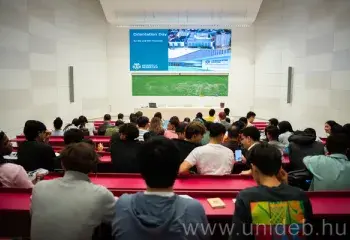
The Orientation Day held at the Faculty of Engineering of the University of Debrecen focused on introducing the mandatory academic administrative procedures for first-year international students. The presentations delivered in English on this day covered topics like the infrastructure of the faculty, the way to register for courses in the Neptun system, and the introduction of an overview of the web-based systems at our university.